
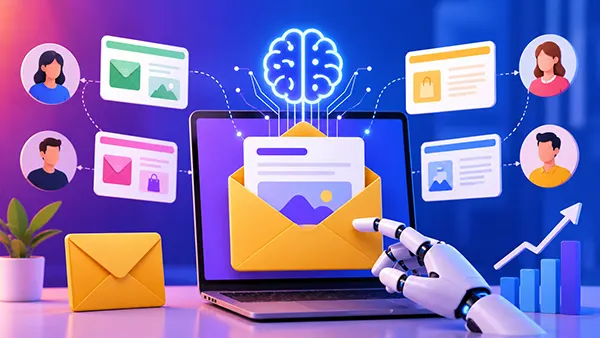
How Email Marketing Is Changing Through AI Personalisation
Email marketing remains one of the most effective digital communication channels in 2026, but the way campaigns are created and delivered has changed significantly. Artificial intelligence has moved beyond simple automation and now plays a central role in understanding customer behaviour, predicting preferences, and delivering highly relevant content. Companies across retail, finance, software, healthcare, and professional services increasingly rely on AI-driven personalisation to improve engagement, strengthen customer relationships, and achieve measurable business results.
The Shift from Segmentation to Individual-Level Communication
For many years, marketers organised subscribers into broad groups based on age, location, purchase history, or interests. While segmentation remains useful, modern AI systems can analyse thousands of behavioural signals simultaneously. These include browsing activity, purchase frequency, product preferences, email interactions, customer support conversations, and even seasonal behaviour patterns.
As a result, businesses are moving towards individual-level communication. Instead of sending the same message to thousands of people within a segment, AI can generate unique email variations tailored to each recipient. Product recommendations, offers, subject lines, and content blocks can all be adjusted automatically according to the predicted interests of the individual reader.
This approach increases relevance while reducing unnecessary communication. Subscribers receive content that aligns more closely with their current needs, which can lead to higher open rates, stronger engagement, and improved customer satisfaction. The emphasis is shifting from mass messaging towards personalised experiences built around customer intent.
How AI Understands Subscriber Behaviour
Modern AI models process large volumes of historical and real-time data to identify patterns that humans would struggle to detect manually. They evaluate how subscribers interact with websites, mobile applications, previous campaigns, and purchasing journeys. These insights allow marketers to predict what a customer may be interested in next.
Predictive analytics has become a major component of email personalisation. AI can estimate the likelihood of a purchase, identify customers who may stop engaging with a brand, and determine which products are most likely to attract attention. This allows businesses to intervene with relevant communications before engagement declines.
Behavioural analysis also helps companies understand changing customer interests over time. Instead of relying on outdated profile information, AI continuously updates its understanding of each subscriber, ensuring that email content remains relevant even as consumer preferences evolve.
AI-Generated Content and Dynamic Email Experiences
Artificial intelligence is increasingly involved in content creation. Many email marketing teams now use AI tools to generate subject lines, draft marketing copy, create product descriptions, and suggest calls to action. Human oversight remains important, but AI significantly reduces the time required to produce campaign materials.
Dynamic content has become another important development. A single email template can display different headlines, images, recommendations, and promotional offers depending on who opens the message. The content is selected automatically based on customer data and behavioural predictions generated by AI systems.
This level of adaptability helps brands communicate with diverse audiences without creating dozens of separate campaigns. Instead of manually building multiple versions, marketers establish strategic goals while AI handles many of the personalisation decisions during delivery.
The Evolution of Subject Lines and Send-Time Optimisation
Subject lines have traditionally been created through manual brainstorming and A/B testing. In 2026, AI systems analyse historical performance data across millions of interactions to generate subject lines that are more likely to resonate with specific audiences. Some systems even personalise subject lines for individual recipients.
Send-time optimisation has also advanced considerably. AI evaluates when each subscriber is most likely to engage with emails based on previous behaviour. Rather than delivering messages at a fixed time, campaigns can be distributed throughout the day according to individual engagement patterns.
These improvements help marketers reach subscribers when attention levels are highest. Better timing combined with personalised messaging can increase visibility without increasing email volume, making campaigns more efficient and less intrusive.

Privacy, Trust, and the Future of AI-Powered Email Marketing
As AI personalisation becomes more sophisticated, businesses must balance relevance with responsible data usage. Consumers are increasingly aware of how their information is collected and processed. Regulations in many regions continue to require transparency regarding data collection, storage, and marketing practices.
Trust has become a competitive advantage. Organisations that clearly explain how customer information is used are often better positioned to maintain long-term relationships. AI can support personalisation, but successful strategies depend on ethical implementation and clear communication with subscribers.
The future of email marketing will likely involve stronger integration between AI systems, customer data platforms, and omnichannel marketing environments. Email campaigns will increasingly operate as part of broader customer journeys that include websites, mobile applications, social media, and customer support interactions.
What Businesses Should Expect in the Coming Years
AI models are expected to become more accurate in predicting customer intentions. Rather than reacting to previous actions, future systems will focus on anticipating needs before customers actively express them. This could enable more proactive and useful communication strategies.
Generative AI will continue improving content production, but human expertise will remain essential. Marketing professionals will increasingly focus on strategy, brand positioning, compliance, and customer experience while AI handles repetitive analytical and creative tasks.
Email marketing in 2026 is no longer centred on sending large volumes of messages. Success increasingly depends on delivering relevant information to the right person at the right moment. AI personalisation is transforming email from a broadcast channel into a highly adaptive communication tool that supports stronger customer relationships and more effective business outcomes.